
REVOLUTION EQUINE
Horseshit or Horsemanship: Learn to tell the difference.
Peace and certainty in 3 hours or less.
Evaluate the explanation against what hard science says.
Start the course — US$99US$99 for the first 25 paid participants, then US$149.
One payment. 14 days’ course access. Ongoing community access.
Have you ever wondered why people all do the same things with horses and call it something different?
We may get a response. We may even get the response we wanted.
But what happened to the horse? What did the horse learn? And what do we believe we have achieved?
Imagine how it’d feel to spend years, tens of thousands of dollars, trust in people only to learn everything you were taught could be explained in less than 3 hours and worse – what you’ve learned, been taught and worked so hard for including paying good money resulted in compromising the integrity and wellbeing of the very thing you cared about.
It doesn’t have to be that way.
A horse can give the right answer—and the explanation can still be wrong.
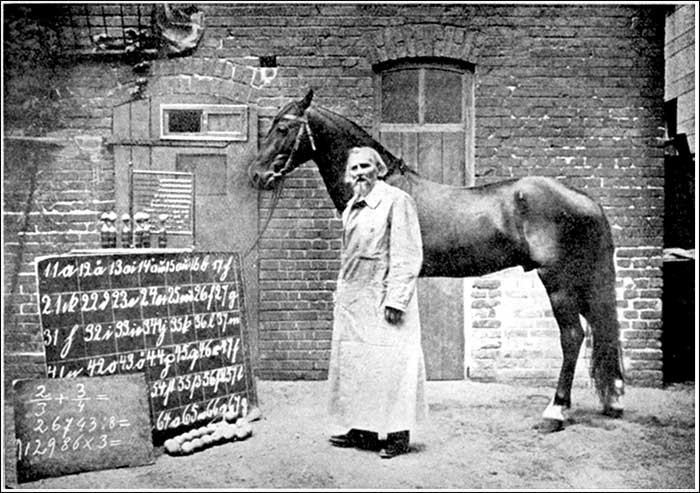
In early twentieth-century Berlin, von Osten believed he had taught an Orlov Trotter arithmetic, reading, spelling and telling time.
Ask a question. Hans would tap out an answer with his hoof.
The horse really tapped. The answers really were frequently correct.
The observations were real. The explanation was incorrect.
Then psychologist Oskar Pfungst investigated.
His experiments addressed two decisive conditions: whether the questioner knew the answer, and whether Hans could see the questioner.
When the questioner did not know the answer, Hans’s accuracy deteriorated. When Hans could not see the relevant human movements, his apparent mathematical ability disappeared.
Pfungst identified minute movements that people did not realize they were making.
A slight inclination helped initiate tapping. As the expected number approached, the questioner’s posture and tension changed. A small movement at the expected answer signaled Hans to stop.
Hans had learned to respond to those signals.
A person can be sincere, observant, experienced and completely mistaken about what they are teaching.
The horse’s response can then strengthen that mistake.
Now move it into an arena.
A handler believes a horse is challenging their authority. That belief justifies stronger pressure. The horse’s behavior changes. The handler calls the change “respect.”
But did the horse learn a clear response to a clear signal? Was movement physically prevented? Did fear inhibit the behavior? Could the horse do anything that reliably improved its situation?
Those are different processes with different consequences.
Calling all of them “training” conceals the distinction.
What you’ll be able to do
By the end, you will be able to identify how horses are being ridden and trained, how to get the results you want yourself, and how to ensure your horse is comfortable and enriched by your experience together rather than subjected to interpretations that compromise its performance and wellbeing.
Tell the difference by evaluating the explanation against what hard science says: dirty lies, half truths and unearned authority over what you do with your horse and how it actually works.
The course
For riders, trainers and equine professionals. The existing masterclass and foundation material are selected and adapted to deliver the explanation and its application in 3 hours or less.
Why people predictably mistake a horse’s response for validation of their interpretation and understanding—and how that mistake costs people and horses more than time or money—is part of the core curriculum.
- The response is real. Is the explanation?
- The horse and the foundation every maneuver uses
- How and why people get horses to respond
- Use the mechanics to shape the result deliberately
- Why people get it wrong—and what it costs
- Avoid the predictable plateaus and failures
Your learning guarantee
Your uncertainty relief is 100% guaranteed.
If you don’t understand the curriculum or have limiting questions we’ll answer them directly and if needed will hop on a complimentary 20 minute call to make sure you’re comfortable and confident in what you’ve learned.
For curriculum or access help, open Member Support to email Revolution Equine.
Price and access
US$99 for the first 25 paid participants.
Save US$50 at the introductory price. Then US$149.
One payment. 14 days’ course access. Ongoing community access.
Start the course — US$99Chase Hallquist
Animal scientist · Revolution Equine